
'/%3e%3cdefs%3e%3clinearGradient%20id='prefix__paint0_linear_4737_37157'%20x1='3.018'%20y1='23.6'%20x2='44.925'%20y2='24.977'%20gradientUnits='userSpaceOnUse'%3e%3cstop%20stop-color='%231CB7FF'/%3e%3cstop%20offset='.502'%20stop-color='%232FF58B'/%3e%3c/linearGradient%3e%3c/defs%3e%3c/svg%3e)


Infantino's offer: take Mexico out of Concacaf and put it into Conmebol in exchange for its vote
Aug 11 2026 12:51 · By FABIAN TORRES · 43 Reads


The FMF would have reached that agreement with the current FIFA president so that the Swiss can remain in the presidency
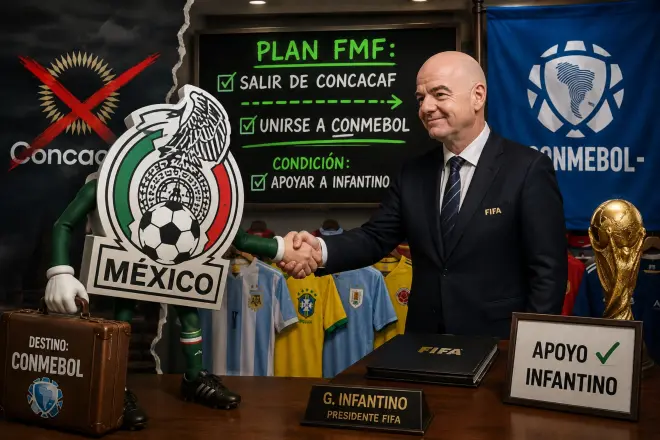

The FMF would have received a proposal from Gianni Infantino: he would help Mexico leave Concacaf to join Conmebol, in exchange for guaranteeing him their vote in the next FIFA presidential election.
This information was revealed by journalist Martín del Palacio, who stated that the support of the Mexican Football Federation (FMF) would be key for the Swiss official to remain at the helm of the highest governing body of world football. However, the change of confederation would not be easy, as it would require approval through different filters. Despite this, in Mexico they view favorably an option that would happen only and exclusively if the current president remains in office.
This alleged invitation from Infantino to the FMF to move to South America would be conditional on Mexico speaking out in support of his candidacy. In this way, he would seek to clean up an image that has been badly damaged after his attempt to modify World Cup logistics.
With this stance, it is clear the major rift between the FMF and Concacaf, a confederation that aligned itself with UEFA and the AFC to issue a harsh statement against Infantino's attempts to privatize the management of the World Cups starting with the 2030 edition.
The FMF had already expressed, through a joint statement with Conmebol, its support for Gianni Infantino, aligning itself with a management that came under scrutiny just seven months before the elections. However, these messages have been described as "lukewarm" by the football community, especially after UEFA, Concacaf, and the AFC stated emphatically that they are seeking the removal of the Swiss executive.
The pros and cons of Mexico in CONMEBOL
Joining Conmebol would greatly benefit the Mexican National Team from a sporting standpoint. Facing powerhouses like Argentina, Brazil, Uruguay, and Colombia on a more regular basis would raise the competitive level of its players. Likewise, the constant exposure in these demanding matchups would foster El Tri's footballing development.
In contrast, the main obstacle to this possible change would lie in the logistics. The trips would be much longer, which would increase the physical and financial strain, since the participation of Mexican clubs in the Copa Libertadores and Copa Sudamericana would be added to the national team’s matches. In addition, the FMF would have to resolve the existing sponsorship agreements for El Tri to play in the United States, a key market where millions of fellow countrymen fill the stadiums at every appearance of the national team.