
'/%3e%3cdefs%3e%3clinearGradient%20id='prefix__paint0_linear_4737_37157'%20x1='3.018'%20y1='23.6'%20x2='44.925'%20y2='24.977'%20gradientUnits='userSpaceOnUse'%3e%3cstop%20stop-color='%231CB7FF'/%3e%3cstop%20offset='.502'%20stop-color='%232FF58B'/%3e%3c/linearGradient%3e%3c/defs%3e%3c/svg%3e)


The Enzo Fernandez problem that Man City must solve
Sep 21 2026 08:49 · By onefootball.com · 23 Reads



On a very strange afternoon, one of the odder incidents was among the last. When Enzo Fernandez was announced as the man of the match, it felt about 80 minutes too late. If Manchester City’s win over Sunderland had been curtailed after 10 minutes, the outstanding quality of his opening goal and the considerable chutzpah it entailed, would have rendered him a worthy winner.
Another seven goals later, when Fernandez was anointed, there were jeers from the Sunderland supporters. Perhaps that was inevitable: the Argentine is the Premier League’s pantomime villain and the City faithful have rather embraced his notoriety. Maybe it was a reaction because Brian Brobbey was a more deserving recipient, though even a historic hat-trick from a visiting player is still never likely to earn recognition when the home club picks the winner.
But some of the bafflement reflected the game, and Fernandez’s role in it. City’s 5-3 victory showed first his strengths and then his weaknesses; or, perhaps more accurately, the reasons to wonder if he was really what City needed.

open image in gallery
Was Enzo Fernandez really what Man City needed this summer? (Getty)
In many ways, Fernandez has settled in seamlessly, looking undaunted by his £125m price tag or the status as the joint record British signing. Chelsea finished 12th, sixth, fourth and 10th in his three-and-a-half seasons at Stamford Bridge and there is an argument that he plays better alongside better players.
He was excellent in a difficult away game in the Champions League at Porto, providing the chipped cross for Erling Haaland’s opener and seeming to strike up a relationship with the striker. He was better still in the Manchester derby, appearing to relish the challenge when City were reduced to 10 men.
This Sunday brought his first City goal; indeed his first for anyone since his spectacular equaliser in the World Cup semi-final. He has taken No 17 shirt that used to belong to Kevin De Bruyne and some of the set-piece duties, too. His was a free kick of imagination and precision, from an acute angle where even a left-footer would be unlikely to shoot and a right-footer certainly wouldn’t. Perhaps that was Robin Roefs’ thinking, anyway, as the Sunderland goalkeeper was caught out when Fernandez whipped it around his wall and in at the near post.
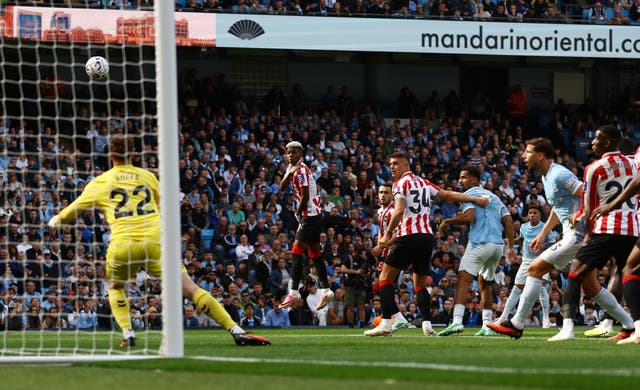
Fernandez’s audacious free-kick did open the scoring against Sunderland (Reuters)
Yet what followed indicated the issues with Fernandez. Some revolve around discipline; though not the bad behaviour Chelsea and Benfica may bemoan. But positional discipline is a concern. Fernandez can be a frustrated No 10. Some of Maresca’s instructions involve him moving towards the touchline. At times, he looked more like an inside-right.
But as Sunderland often dominated in the centre, as chaos enveloped the Etihad Stadium, Elliot Anderson appeared to be a one-man midfield, and even a £116m midfielder can struggle against multiple opponents. Fernandez, to his credit, had shown more positional discipline when City had 10 men in the Manchester derby. He displayed less with 11 the following Sunday.
How much of it is managerial instruction, how much of it a midfielder’s wanderlust? It is hard to say, but a word Maresca invoked after the game was “balance”. City lacked it. They don’t yet have the coherence of a Pep Guardiola midfield.

Fernandez’s lack of positional discipline left Elliot Anderson exposed, despite scoring a goal (PA)
And City spent £326m to move on from Guardiola’s last midfield. That budget ought to have allowed them to construct something with more solidity. But City lost the world’s best defensive midfielder, in Rodri, and a player who occupied a host of roles but ended up in a deeper role alongside the Spaniard, in Bernardo Silva.
The curiosity is that, of the four midfielders who left the Etihad in the summer, the man whose touch map might be most reminiscent of something Fernandez would produce now is Tijjani Reijnders, an attacking runner who lost his place. City did not really need a Reijnders replacement.
Fernandez seemed hired as a defensive midfielder by Chelsea and gravitated further forwards. But City’s great discovery last season, and most magical player now, is Rayan Cherki, a No 10 who benefits from a duo providing defensive protection behind him.

Enzo MAresca may have to choose Rayan Cherki or Fernandez (Getty)
Perhaps each wants the freedom they would be afforded by a pairing of Anderson and Ayyoub Bouaddi behind them. If so, it could be a choice between them if the Moroccan is selected. If not, and if Fernandez continues to vacate the centre of the pitch, Anderson could be the most overworked player in the Premier League.
Maybe these are teething troubles. Fernandez knows Maresca and his demands, but has had less time with his new teammates. Maybe this was a one-off: City had four straight clean sheets before Sunderland scored three times.
But Fernandez has arrived after a decade in which City midfields usually offered control, where Guardiola’s philosophy was to outnumber opponents in the centre of the pitch. And as Anderson looked distinctly lonely against Sunderland, the sense was that City’s £125m midfielder needed to be in the middle of the midfield more often, and frequently at the base of it.