
'/%3e%3cdefs%3e%3clinearGradient%20id='prefix__paint0_linear_4737_37157'%20x1='3.018'%20y1='23.6'%20x2='44.925'%20y2='24.977'%20gradientUnits='userSpaceOnUse'%3e%3cstop%20stop-color='%231CB7FF'/%3e%3cstop%20offset='.502'%20stop-color='%232FF58B'/%3e%3c/linearGradient%3e%3c/defs%3e%3c/svg%3e)


The Athletic: Mike D’Antoni was more than ‘seven seconds or less’ in his Hall of Fame career
Aug 14 2026 21:18 · By John Hollinger, The Athletic · 20 Reads


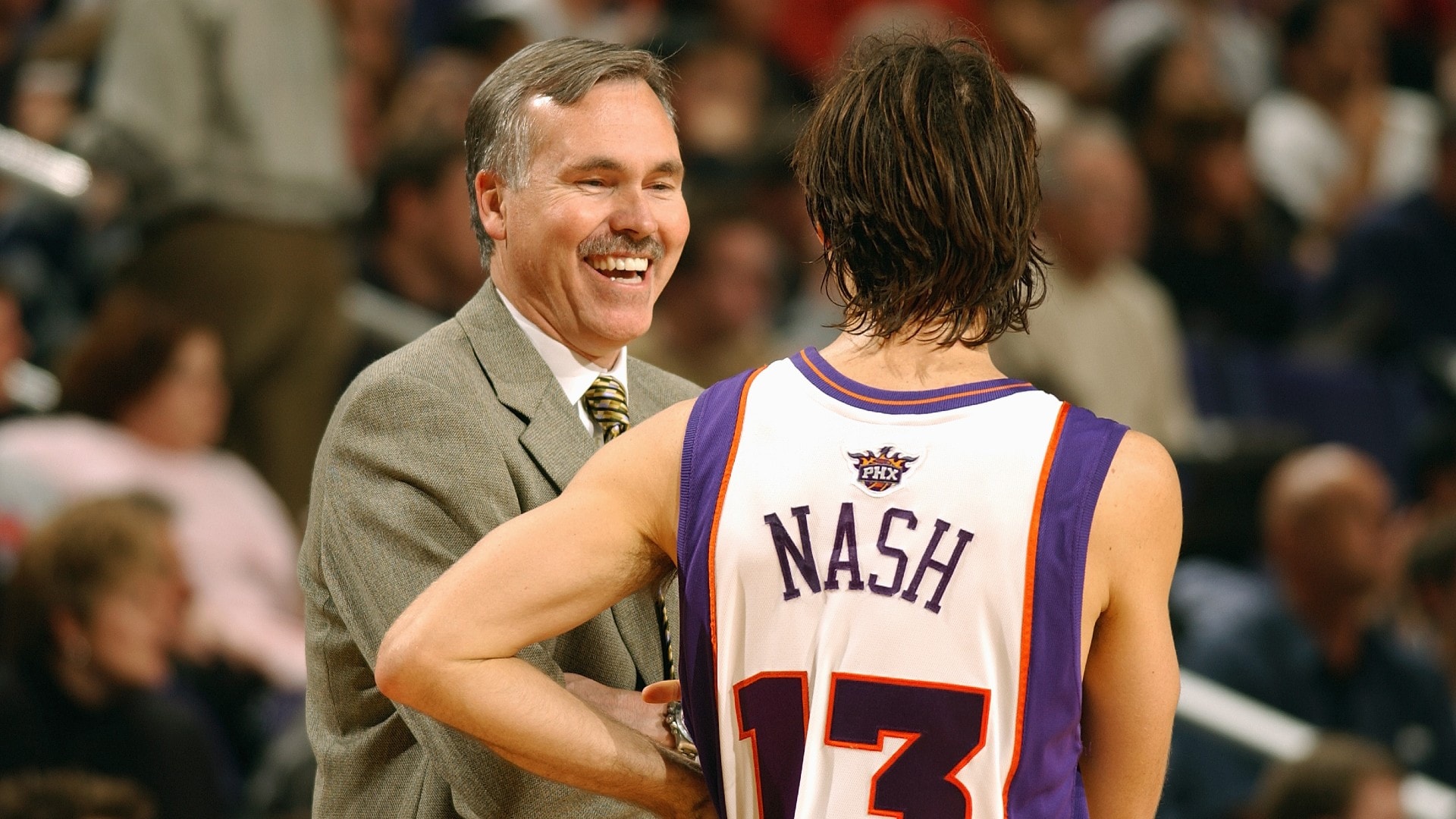
Mike D’Antoni’s Suns played the game different from any other team in the early 2000s.
Editor’s Note: Read more NBA coverage from The Athletic
here
. The views on this page do not necessarily reflect the views of the NBA or its teams.
***
In the summer of 2004, Mike D’Antoni was 53 years old and had a career record of 35-76 as an NBA coach.
His future induction into the Basketball Hall of Fame seemed … unlikely.
Yet here we are, more than two decades later, and D’Antoni is heading into the Hall of Fame this weekend. From 2004 to 2020, he won 672 games, two Coach of the Year awards and six division titles. He made three conference finals, delivered seven 50-win seasons and three 60-win seasons. His 65-win Houston Rockets team in 2018 has a strong case as the best team in NBA annals to not win a title.
Even those numbers don’t exactly explain why D’Antoni was such an obvious choice for the Hall. To do that, it might be better to zoom in on a much smaller sample: the first 35 games of the 2004-05 season.
I’m not sure any coach in any sport in the past half century has knocked a professional league on its rear end the way D’Antoni did in the fall of 2004, his first full campaign at the helm of the Phoenix Suns after taking over for Frank Johnson midway through the previous season.
He took a team that won 29 games the year before, with many of the same players (albeit with Steve Nash replacing Stephon Marbury) … and started the next season 31-4. The Suns had 48 games left on their schedule when they exceeded the previous year’s win total.
The Suns, who were 21st in offensive efficiency the year before, not only led the league in that category in 2004-05, but they blew it away. Relative to the league average, they were the second-best offense in NBA history, finishing 8.4 points per 100 possessions above the norm.
“Seven seconds or less” is the phrase indelibly associated with D’Antoni for those who need to describe his impact in, well, seven seconds or less. However, it might be the least interesting thing about his offensive concept.
Sure, the Suns played fast. Their league-leading pace was five possessions faster than the league average (95.9 possessions per 48 minutes might seem somnambulant in 2026, yet it was exhilarating in 2004). But the Suns were a fast team the year before, and they were still terrible.
In fact, the “pace-and-space” era that D’Antoni’s Suns team turbo-launched into existence was much more a function of the “space” part. D’Antoni would prove that point on pace more emphatically later in his career, when that 65-win Rockets team led the NBA in offensive efficiency while ranking just 13th in pace under the more methodical styles of James Harden and Chris Paul.
The real enduring secret of D’Antoni’s success is how he leaned into smaller, faster lineups and 3-point shots and allowed talented guards to thrive. It’s not like he was the first to discover the value of floor spacing or the added value of a 3-pointer, but D’Antoni was the one who weaponized it into an entire system. He did so, in part, by having the humility to get out of his stars’ way.
“He saw his job as maximizing the players and letting the players be the centerpiece,” said former Rockets and Sixers executive Daryl Morey, who paired with D’Antoni for four seasons in Houston.
To wit: Nobody thinks twice about playing a 6-foot-7, 210-pound guy at power forward anymore, but when D’Antoni did it with Shawn Marion, it was revolutionary — with Amar’e Stoudemire, who also will be inducted into the Hall of Fame this weekend, moving to center. This was the NBA’s era of giants, and the thought was that you had to match up with the Shaquille O’Neals and Tim Duncans of the league to have any chance.
Nobody played “four out” that much either, to the point where the idea of a “stretch four” was a specialist role. Even the previous year, the Suns used a traditional frontcourt with Stoudemire next to Jake Voskuhl.
Instead, D’Antoni surrounded the floor with shooting, spammed high pick-and-rolls with Nash and dared everyone to keep up. The reason this no longer sounds revolutionary is that now everybody does it. It took about a dozen years for every other team to realize it had to play that way, too.
A good example of that Suns team’s impact is looking at something stat nerds call the “Moreyball rate.” Named after Morey, it’s the percentage of a team’s shots that are either beyond the 3-point line or inside 3 feet.
In 2003-04, the league-average Moreyball rate was 48.6 percent, and the league-leading mark belonged to New Orleans at 54.6 percent, according to Basketball-Reference.com. D’Antoni’s 2004-05 Suns had a 58.9 percent Moreyball rate, including a then-staggering rate of 28.9 percent of their shots from beyond the arc.
To make the enormity of that latter number clear, Phoenix took twice as many 3s as seven teams, and the two starting wings alone (Quentin Richardson and Joe Johnson) combined to take more 3-point attempts than eight of the league’s other 29 squads.
The league-wide Moreyball figure has risen inexorably ever since, with last season’s Boston Celtics having a 71.3 percent Moreyball rate and even a middling team like the Portland Trail Blazers sporting a mark of 70.6 percent. (Irony alert: The worst Moreyball rate in 2025-26 belonged to the Suns, whose 58.3 percent fell just short of the mark they put up under D’Antoni 21 years earlier.)
Along the way, nobody did more to drag the NBA out of its plodding turn-of-the-century doldrums into the pace-and-space fireworks that we see today than D’Antoni. Remember: The 2004 Eastern Conference finals had games in which the winning team scored 69, 72 and 78 points. The Suns averaging 110.4 points in 2004-05 was such an outlier that they increased the league average by nearly half a point by themselves. Their brethren averaged less than 97.
That system in Phoenix also had some added layers that don’t get talked about often enough. The Suns never fouled and rarely committed dead-ball turnovers, such that their games contained much longer sequences of back-and-forth action than most, which only allowed them to turn the screws even further with their speed and skill advantages. (That was partly due to another D’Antoni innovation that since has been widely copied: switching nearly everything on the perimeter, even with susceptible defenders like Nash.)
D’Antoni was an innovator and tinkerer who had some funky wrinkles in his playbook, too, notably the four-five pick-and-roll between Marion and Stoudemire that started just above the free-throw line. That play befuddled defenses almost as much as Nash’s pick-and-rolls.
D’Antoni’s four-year run in Phoenix was awesome. The Suns finished first in offensive efficiency three times and were second the other year, when they won 52 games and made the Western Conference finals despite losing Stoudemire for all but three games. The postscript to D’Antoni’s departure underscored his effectiveness. The team scuffled to a 28-23 start under Terry Porter before replacing him at midseason with Alvin Gentry and going back to D’Antoni’s system. A year later, they were back in the conference finals.
However, it was his second act in Houston that showed D’Antoni’s success was about a lot more than one offensive life hack. By 2016, other teams had imitated D’Antoni’s success, and his subsequent stints with the Los Angeles Lakers and New York Knicks hadn’t turned out well.
“We were looking for a partner and an innovator,” said Morey, who interviewed at least a dozen candidates in the summer of 2016 before hiring D’Antoni. “Somebody who would throw back as many ideas at us as we threw at him.”
D’Antoni unleashed Harden in a way no coach had previously, resulting in eye-popping numbers for both player and team. D’Antoni put the ball in his hands and got out of the way, with Harden’s usage erupting from 32.5 percent in the pre-D’Antoni 2015-16 season to 34.2 percent, then 36.2 percent, then a whopping 40.5 percent.
Harden led the league in assists his first season with D’Antoni and in scoring the next three, led the league in win shares in all four seasons with D’Antoni and set an NBA record that still stands with a staggering 1,028 3-point attempts in 2017-18. (For comparison’s sake, the best non-Harden number is Steph Curry’s 876 in 2023-24.)
Those Houston teams let it fly like no team in history. D’Antoni’s Rockets teams took more than half their shots from beyond the arc in each of his last three seasons (50.2 percent in 2017-18, 51.9 percent in 20-18-19 and 50.1 percent in 2019-20), the only times that had happened in NBA history until the Celtics topped them in 2024-25.
Even Paul got in on the act. The master of the free throw line pull-up embraced the 3-ball as a Rocket, raining nearly half his shots from 3 in his two seasons in Houston (47.5 percent and 49.3 percent), a figure that blew away his number in any of his other 21 NBA seasons.
As with any revolution, timing matters. In 2004, the NBA had just relaxed hand-checking rules to make it easier for mobile guards to create, and the Suns had the perfect storm in the arrival of Nash to operate D’Antoni’s system and the volcanic dunks of Stoudemire to finish his passes. And in Houston, D’Antoni had the perfect “rim-and-3s” centerpiece in Harden, resulting in a staggering 79.0 percent Moreyball rate for the 2017-18 squad.
But it takes more than just players and a system to win as much as D’Antoni did.
“There’s an art to optimizing it,” Morey said. “You and I both know teams where they had very talented players, and it didn’t mesh well. One of Mike’s strengths was figuring out how to get the most out of everyone, such as having James [Harden] be on ball more than he had ever been; that was absolutely the right move, and it worked.”
D’Antoni never got a ring, with his Suns and Rockets squads arguably the two best teams this century that failed to win one. The controversial suspension of Stoudemire and Boris Diaw in the 2007 conference semifinals against the Spurs and Paul’s hamstring injury against the mighty Golden State Warriors in 2018 are the two nagging what-ifs. Nonetheless, you’d have a hard time naming more than a few coaches in the past half century who impacted the league more than D’Antoni.
That’s why “seven seconds or less” doesn’t do him justice. D’Antoni’s fingerprints run much deeper than just an arbitrary end point on the shot clock. In 2004, he did something completely revolutionary, and it worked so well the league had no choice but to copy him. Then, for good measure, he added another revolution a dozen years later that still hasn’t been matched.
Basketball in the 2000s wouldn’t look nearly the same without him.
John Hollinger
’s two decades of NBA experience include seven seasons as the Memphis Grizzlies’ Vice President of Basketball Operations and media stints at ESPN.com and SI.com. A pioneer in basketball analytics, he invented several advanced metrics — most notably, the PER standard. He also authored four editions of “Pro Basketball Forecast.” In 2018 he was honored with the Lifetime Achievement Award at the Sloan Sports Analytics Conference. You can follow John on X
@johnhollinger
.