
'/%3e%3cdefs%3e%3clinearGradient%20id='prefix__paint0_linear_4737_37157'%20x1='3.018'%20y1='23.6'%20x2='44.925'%20y2='24.977'%20gradientUnits='userSpaceOnUse'%3e%3cstop%20stop-color='%231CB7FF'/%3e%3cstop%20offset='.502'%20stop-color='%232FF58B'/%3e%3c/linearGradient%3e%3c/defs%3e%3c/svg%3e)


Everton’s underlying numbers show the attack is getting better
Sep 22 2026 10:49 · By onefootball.com · 13 Reads


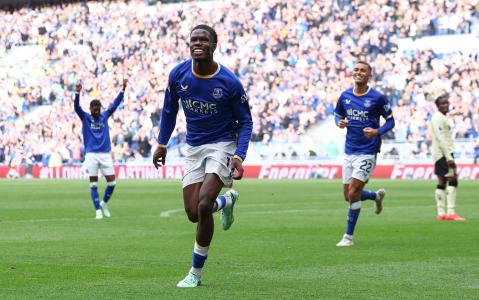
(Photo by Molly Darlington/Getty Images)
Last season, Everton were keen to stress the strength of their defence. Only three teams kept more Premier League clean sheets than Everton’s 11, while the Toffees’ tally of 50 goals conceded ranked as the sixth best in the division.
However, that didn’t tell the whole story, as Everton’s expected goals against (xGA) — which is a metric to show the quality of chances a team gives up — ultimately rounded off at 56.5. Essentially, Everton, through luck, poor finishing and/or some quality goalkeeping from Jordan Pickford, conceded around six goals fewer than would have been anticipated, and only five teams, including the three sides that went down, had a higher xGA across the campaign.
And while Everton rode their luck defensively, there were also very clear problems offensively.
Everton scored only 47 goals (just five teams netted fewer) and their 46.7 xG ranked 14th in the Premier League. Essentially, they scored as many goals as would have been anticipated based on the quality of chances they created across the season.
Now, stats certainly aren’t everything — Sunderland, for example, had a high xGA and a low xG for, yet qualified for the Europa League. But in Everton’s case, the underlying metrics eventually came back to bite; they regressed to the mean and that’s what we saw in that dreadful run-in.
But so far this term, things are starting to shift, especially when it comes to the attack.
However, let’s start out with the defence first, just to give us a grounding.
Everton’s xGA across their opening five league games comes in at a respectable 6.9. That ranks 7th in the top flight, behind Manchester United (6.8), Leeds United (6.5), Brentford (6.3), Liverpool (6.1), Nottingham Forest (4.8) and Arsenal (4.0).
They are giving up only 0.1 xG per shot, which is a figure bettered by only Brentford (0.09), Newcastle United (0.09), Forest (0.09), Leeds (0.09) and Arsenal (0.08), and Everton’s tally of 3 goals conceded is a joint-league best, along with Leeds. The Toffees are one of five teams to have kept 3 clean sheets, too.
David Moyes will be delighted, and Everton’s defensive improvements seem to align with Jarrad Branthwaite’s return to fitness. There has been a slight overperformance, and that’s one to keep an eye on, as the Toffees regularly overperformed their xGA last season, right up until that sudden drop-off from April onwards.
But now, onto the attack, where — at least in terms of chance creation — the improvement is there.
“We’re attempting to play in a way where we can try and produce more opportunities, and we have in the main, but we’ve not been taking them,” Moyes said in his post-match press conference following the 1-0 win over Ipswich Town, as quoted by The Athletic.
“I’m disappointed that we’ve not scored more goals. I’m ratting them like you couldn’t believe at the moment. ‘Why are we not scoring more goals, getting better crosses in, better finishes, shooting from the edge of the box, etc?’, because I think that’s one of the things we’re missing from being a half-decent side.”
Only five teams have scored fewer Premier League goals than Everton (6) so far this season, but the Toffees are underperforming when it comes to their xG.
Their 7.3 xG ranks 11th, just above Chelsea, who have the brilliance of Cole Palmer, Morgan Rogers and Joao Pedro to call on.
Sure, Moyes’ men still rank someway behind the best attacking teams (the top five so far is Brighton, Manchester City, Brentford, Manchester United and Sunderland), but Everton are so far on track to register 55.5 xG across the season. That would be a sizeable uplift on last term (46.7).
I’m well aware, stats aren’t for everybody, but in this case these underlying metrics at least help paint a picture. They back up what Moyes has said, and a quick “eye test” does too.
Everton have spurned some glorious chances, and while that should not be lauded, it does at least show that those opportunities are being created with some measure of regularity, even if it is across a small sample size.
The Toffees have already had 80 shots in the Premier League this season, which is a tally bettered by only four teams. Their conversion rate (7.5%), however, ranks 15th.
So the evidence is pretty clear: Whatever Everton are doing to create chances at the moment is working, but when it comes to putting those opportunities away, we have an issue.
People might point fingers at Thierno Barry, and perhaps fairly in some regards, as the Frenchman is the league’s second-highest underperformer so far this season when it comes to goals v xG.
Barry’s 3.5 xG ranks 3rd, behind only Erling Haaland and Alexander Isak, yet his 2 goals mean he has underperformed by -1.5. Only Brentford’s Igor Thiago (1 goal from 3.1 xG) has underperformed by a greater amount so far.
Essentially, Barry has had very good chances, but his finishing has been wayward. However, it should be considered a positive that he is getting into those goalscoring positions and that the team are providing service into him. If that keeps happening, then goals should come. If his finishing doesn’t improve, then Everton already know they need a striker anyway.
But then there’s a player like Kiernan Dewsbury-Hall, who was so crucial to Everton’s goalscoring efforts last season. Dewsbury-Hall, it is fair to say, definitely hasn’t clicked into gear yet this term, and even though he is still working as tirelessly as ever, his form just isn’t there right now.
Brennan Johnson has proved he can score goals at this level, but he too has spurned big moments. Grealish is still short of match sharpness, while Tyler Dibling has only just been given the chance to show he can take the bull by the horns, and Tyrique George is another creative option.
It’s far from perfect, but Everton are at least showing they can be dangerous. Now, it’s about adding some composure into the mix.